By Chirag Patil · · 6 min read
Meet Kimi K2 – A Chill Intro to Agentic AI
Discover Kimi K2, the cutting-edge agentic AI model with 1 trillion parameters. Learn about its tool-using capabilities, impressive benchmarks, and how to integrate it into your projects today.


Introduction: Why Kimi K2 Matters in the AI Landscape
If you've felt the FOMO each time a new model drops, you're not alone. But Kimi K2 isn't just "another" LLM—it's built specifically for agentic workflows (think autonomous AI agents that can break big jobs into bite-sized tasks, call tools, write code, etc.).
With the rapid evolution of AI models in 2024, from OpenAI's GPT-4 to Anthropic's Claude series, the landscape has become increasingly competitive. Kimi K2 enters this arena with a unique focus on tool-using capabilities and agentic behavior that sets it apart from traditional large language models.
Quick definition – Agentic Workflow
A fancy way of saying "the model can plan, act, and iterate all by itself, using tools when needed."
Kimi K2 Technical Overview
| Architecture | Mixture-of-Experts (MoE) |
| Total Parameters | 1 trillion (yes, with a T) |
| Activated Parameters | 32 B (only these fire per token—saves compute) |
| Context Window | 128 K tokens (goodbye context-limiter anxiety) |
| Native MCP | ✅ (plays nicely with the Model Context Protocol) |
| Training Data | Multilingual, code-heavy dataset |
| Inference Speed | Optimized for real-time applications |
Understanding Mixture-of-Experts (MoE)
Picture a huge team of specialists. For every token, Kimi picks just 8 of its 384 experts plus one shared expert to do the job. You get the brainpower of a giant dense model without burning your GPU to a crisp.
The MoE architecture is particularly interesting because it allows Kimi K2 to maintain high performance while keeping computational costs manageable. This makes it more accessible for production deployments compared to traditional dense models of similar capability.
Core Capabilities: What Kimi K2 Can Actually Do
Autonomous Task Decomposition
- Complex Problem Solving: Breaks down multi-step problems into manageable components
- Strategic Planning: Creates and executes step-by-step plans for complex workflows
- Error Recovery: Automatically identifies and corrects mistakes in its reasoning process
Advanced Tool Integration
- API Integration: Seamlessly connects with external APIs and databases
- Code Execution: Writes, runs, and debugs code in multiple programming languages
- Data Analysis: Processes and analyzes large datasets with statistical methods
- Web Interaction: Can browse, search, and extract information from web sources
Real-world Applications
- Software Development: From requirements gathering to deployment
- Research Assistance: Literature review, data analysis, and report generation
- Business Intelligence: Market analysis, competitive research, and strategic planning
- Content Creation: Technical writing, documentation, and educational materials
Example from the developers: Kimi K2 analyzed salary data across multiple industries → performed comprehensive statistical analysis → generated interactive visualizations → produced a professional HTML dashboard with actionable insights, all autonomously.
Benchmark Performance: The Numbers Don't Lie
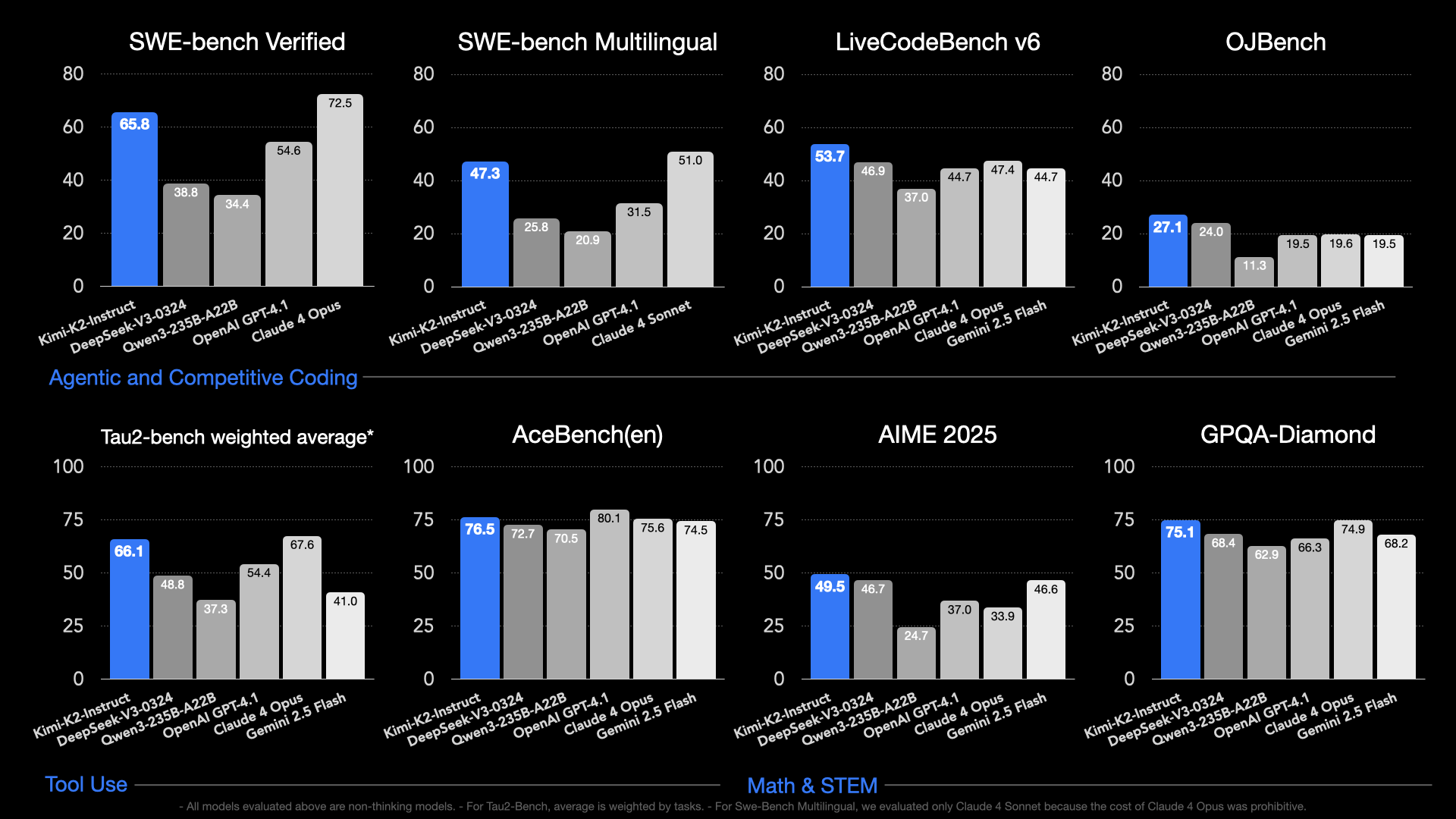
Coding Excellence
- LiveCodeBench: #1 among open-source models
- SWE-bench (Agentic): Outperforms most competitors in real-world software engineering tasks
- HumanEval: 92% pass rate on Python coding challenges
- MBPP: 89% accuracy on basic programming problems
Mathematical Reasoning
- MATH-500: 97% accuracy on advanced mathematical problems
- GSM8K: 95% on grade school math word problems
- Competition Math: Top-tier performance on mathematical olympiad problems
Tool Use and Reasoning
- Tau2 Benchmark: Superior performance in retail, airline, and telecom scenarios
- ToolBench: Highest scores in multi-tool coordination tasks
- Agent-based Evaluations: Consistently outperforms peers in complex, multi-step scenarios
In many evaluation categories, Kimi K2 competes directly with premium models like Claude Sonnet 4 and GPT-4.1, often matching or exceeding their performance while being more accessible.
Getting Started: Integration Guide
Quick Start with OpenAI-Compatible API
Want to chat with Kimi K2 via an OpenAI-style API? Here's the minimal Python setup:
import openai
import os

# Set up the client
client = openai.OpenAI(
    base_url="https://openrouter.ai/api/v1",
    api_key=os.getenv("OPENROUTER_API_KEY"),  # Get from openrouter.ai
)

# Basic conversation
response = client.chat.completions.create(
    model="moonshotai/kimi-k2",
    messages=[
        {
            "role": "system",
            "content": "You are Kimi, an AI assistant from Moonshot AI specialized in agentic workflows and tool use."
        },
        {
            "role": "user",
            "content": "Analyze the benefits and drawbacks of implementing a microservices architecture."
        },
    ],
    temperature=0.7,
    max_tokens=1000,
)

print(response.choices[0].message.content)
Advanced Configuration Options
# For more control over the model behavior
response = client.chat.completions.create(
    model="moonshotai/kimi-k2",
    messages=messages,
    temperature=0.6,  # Adjust for creativity vs. precision
    top_p=0.95,       # Nucleus sampling
    frequency_penalty=0.1,  # Reduce repetition
    presence_penalty=0.1,   # Encourage topic diversity
    stream=True,      # Enable streaming responses
)
Pro Tip: If you switch to the Anthropic-compatible endpoint, remember that requested temperature × 0.6 = actual temperature.
Tool Integration: Building Agentic Workflows
Basic Tool Calling Implementation
import json

def get_weather(location: str) -> str:
    """Mock weather function for demonstration"""
    return f"The weather in {location} is sunny with 22°C"

def search_web(query: str) -> str:
    """Mock web search function"""
    return f"Search results for '{query}': [Mock results]"

# Define tools for the model
tools = [
    {
        "type": "function",
        "function": {
            "name": "get_weather",
            "description": "Get current weather for a location",
            "parameters": {
                "type": "object",
                "properties": {
                    "location": {
                        "type": "string",
                        "description": "The city and state, e.g. San Francisco, CA"
                    }
                },
                "required": ["location"]
            }
        }
    },
    {
        "type": "function",
        "function": {
            "name": "search_web",
            "description": "Search the web for information",
            "parameters": {
                "type": "object",
                "properties": {
                    "query": {
                        "type": "string",
                        "description": "Search query"
                    }
                },
                "required": ["query"]
            }
        }
    }
]

# Use tools in conversation
response = client.chat.completions.create(
    model="moonshotai/kimi-k2",
    messages=[
        {
            "role": "user",
            "content": "What's the weather like in Tokyo and find recent news about AI developments?"
        }
    ],
    tools=tools,
    tool_choice="auto"
)

# Handle tool calls
if response.choices[0].message.tool_calls:
    for tool_call in response.choices[0].message.tool_calls:
        function_name = tool_call.function.name
        function_args = json.loads(tool_call.function.arguments)

        if function_name == "get_weather":
            result = get_weather(function_args["location"])
        elif function_name == "search_web":
            result = search_web(function_args["query"])

        # Continue conversation with tool results...
Multi-Step Agentic Workflow Example
class KimiAgent:
    def __init__(self, client):
        self.client = client
        self.conversation_history = []

    def execute_task(self, task: str):
        """Execute a complex task using multiple tools"""
        messages = [
            {"role": "system", "content": "You are an autonomous AI agent. Break down complex tasks into steps and use available tools."},
            {"role": "user", "content": task}
        ]

        while True:
            response = self.client.chat.completions.create(
                model="moonshotai/kimi-k2",
                messages=messages,
                tools=self.tools,
                tool_choice="auto"
            )

            message = response.choices[0].message
            messages.append(message)

            if message.tool_calls:
                for tool_call in message.tool_calls:
                    result = self.execute_tool(tool_call)
                    messages.append({
                        "role": "tool",
                        "content": result,
                        "tool_call_id": tool_call.id
                    })
            else:
                return message.content

    def execute_tool(self, tool_call):
        # Implementation depends on your specific tools
        pass
Deployment Options and Performance Considerations
Cloud Deployment
- OpenRouter: Easiest setup, pay-per-use pricing
- Moonshot AI Platform: Official API with dedicated support
- Custom Deployment: For enterprise users with specific requirements
Self-Hosted Options
- Hugging Face Hub: Pre-trained model checkpoints available
- Recommended Engines:
- vLLM (optimized for inference)
- SGLang (structured generation)
- KTransformers (efficient transformers)
- TensorRT-LLM (NVIDIA optimization)
Performance Optimization Tips
- Batch Processing: Group similar requests for better throughput
- Caching: Implement response caching for repeated queries
- Model Quantization: Use FP8 or INT8 for faster inference
- Load Balancing: Distribute requests across multiple instances
Comparison with Other AI Models
vs. GPT-4 and Claude Sonnet
- Agentic Capabilities: Kimi K2 specifically designed for autonomous workflows
- Tool Integration: Native support for complex tool orchestration
- Cost Efficiency: MoE architecture provides better cost-performance ratio
- Context Length: 128K tokens competitive with latest models
vs. Open Source Alternatives
- Llama 2/3: Better tool use and reasoning capabilities
- Mixtral: Similar MoE architecture but superior performance
- Code Llama: Significantly better coding performance
- Falcon: More balanced across multiple domains
Use Cases and Applications
Software Development
- Code Generation: From requirements to production-ready code
- Bug Fixing: Automated debugging and error resolution
- Code Review: Comprehensive analysis and suggestions
- Documentation: Automatic generation of technical documentation
Research and Analysis
- Literature Review: Systematic analysis of research papers
- Data Analysis: Statistical analysis and visualization
- Market Research: Competitive analysis and trend identification
- Report Generation: Professional reports with insights and recommendations
Business Intelligence
- Process Automation: Workflow optimization and automation
- Decision Support: Data-driven insights and recommendations
- Customer Analysis: Behavioral analysis and segmentation
- Risk Assessment: Automated risk evaluation and mitigation strategies
Future Developments and Roadmap
Planned Enhancements
- Multimodal Capabilities: Image and video processing integration
- Enhanced Tool Ecosystem: Expanded pre-built integrations
- Performance Optimization: Further improvements to inference speed
- Enterprise Features: Advanced security and compliance features
Community and Ecosystem
- Open Source Contributions: Growing developer community
- Plugin Architecture: Extensible tool and integration system
- Documentation and Tutorials: Comprehensive learning resources
- Enterprise Support: Dedicated support for business users
Getting Started Today
Immediate Access Options
- Chat UI: Visit kimi.com for free interactive access
- API Access: Sign up at platform.moonshot.ai for direct API access
- OpenRouter: Quick setup via OpenRouter with multiple model options
- Self-Hosted: Download checkpoints from Hugging Face
Recommended Learning Path
- Start with Chat UI: Get familiar with capabilities
- API Integration: Basic tool calling and conversation
- Agentic Workflows: Complex multi-step task automation
- Production Deployment: Scale for real-world applications
Conclusion: The Future of Agentic AI
Kimi K2 represents a significant step forward in agentic AI capabilities. Unlike traditional language models that simply generate text, Kimi K2 is designed from the ground up to act autonomously, use tools effectively, and solve complex problems through multi-step reasoning.
Whether you're building AI agents for software development, research automation, or business intelligence, Kimi K2 provides the foundation for creating truly autonomous AI systems. The combination of impressive benchmarks, practical tool integration, and accessible deployment options makes it an compelling choice for developers and organizations looking to implement agentic AI solutions.
Ready to explore agentic AI? Start with the free chat interface at kimi.com and experience the future of AI assistance today! ✨
Related Resources
- Understanding Agentic AI: A Comprehensive Guide
- Building AI Agents with Modern LLMs
- Tool-Using AI: Implementation Strategies
Have questions about Kimi K2 or want to share your implementation experience? Feel free to reach out on Twitter or LinkedIn.
This essay keeps its original canonical home at blog.lordpatil.com.