By Chirag Patil · · 6 min read
OpenAI Just Dropped a Bombshell: Meet gpt-oss, Their New Open-Weight Models
OpenAI has released gpt-oss-120b and gpt-oss-20b as open-weight models under Apache 2.0 license. Discover their impressive benchmarks, efficient MoE architecture, and how they compare to proprietary models.

Introduction: Why This Release Matters
Well, this is big. OpenAI, the company behind the GPT series, has just released two new powerful language models, gpt-oss-120b and gpt-oss-20b, into the wild as open-weight models. And the best part? They're under the Apache 2.0 license. This is a significant move, marking their first major open-source language model release since GPT-2 and signaling a huge win for developers and researchers.
This isn't just about giving away free models; it's about providing powerful, efficient, and highly capable tools designed for real-world applications that you can run on your own hardware.
The New Kids on the Block: gpt-oss-120b and gpt-oss-20b
So, what are we looking at? These models are built for performance and efficiency, leveraging a Mixture-of-Experts (MoE) architecture.
gpt-oss-120b: The Heavyweight Champion
- Total Parameters: 117 billion (yes, with a B)
- Activated Parameters: Only 5.1 billion per token (MoE efficiency)
- Memory Requirement: Engineered to run on a single 80 GB GPU
- Use Case: High-performance applications, research, enterprise deployments
gpt-oss-20b: The Nimble Sibling
- Total Parameters: 21 billion
- Activated Parameters: 3.6 billion per token
- Memory Requirement: Runs on devices with as little as 16 GB memory
- Use Case: Edge computing, rapid prototyping, on-device AI
Both models are fine-tuned for agentic workflows, excel at following instructions, and support Chain-of-Thought (CoT) reasoning right out of the box.
Understanding Mixture-of-Experts (MoE)
Picture a huge team of specialists. For every token, the model picks just a subset of its experts to do the job. You get the brainpower of a giant dense model without burning your GPU to a crisp.
So, How Good Are They, Really?
OpenAI didn't just release these models; they benchmarked them against their own highly capable proprietary "mini" models, o3-mini and o4-mini. The results are fascinating.
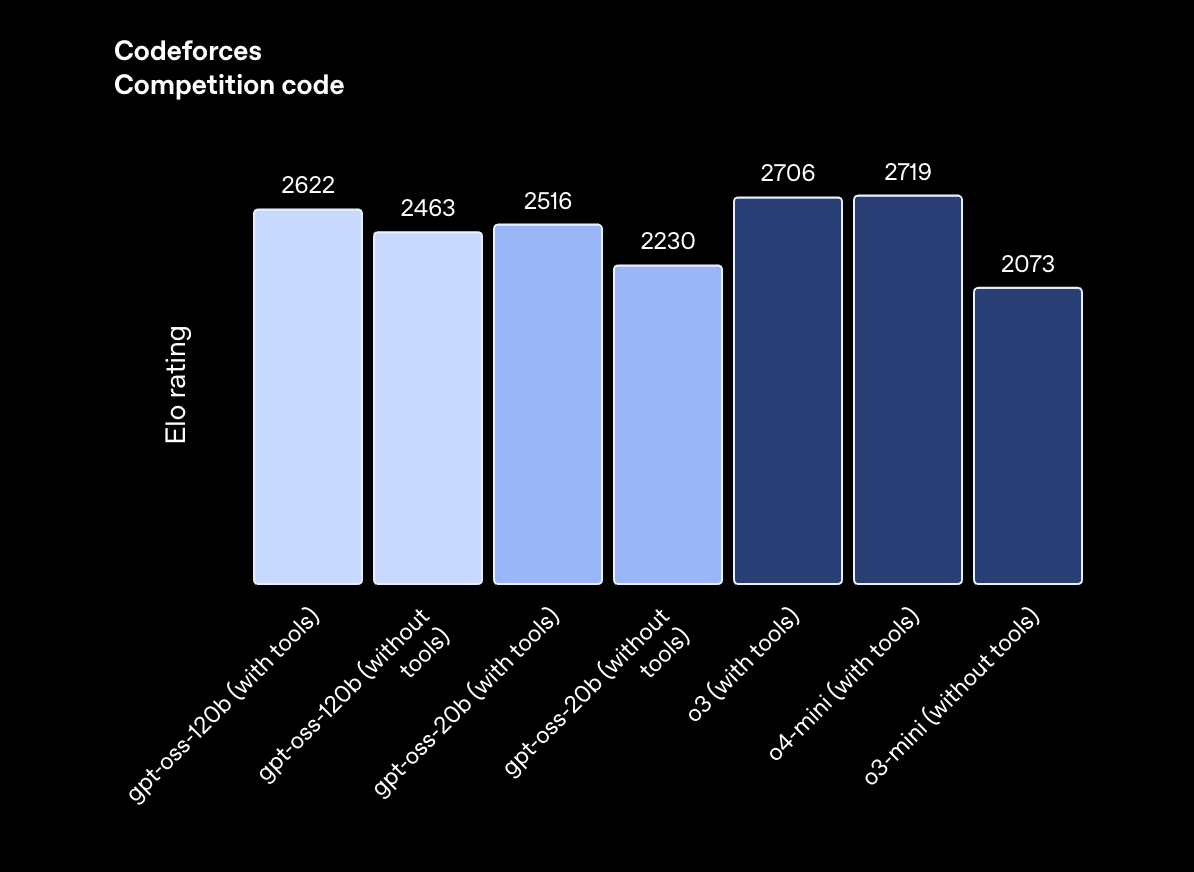
Coding Excellence
In the Codeforces benchmark, which measures competitive coding ability, gpt-oss-120b (with tools) is right up there with o4-mini, showing it's a formidable coding assistant.
Health Queries: Where They Really Shine
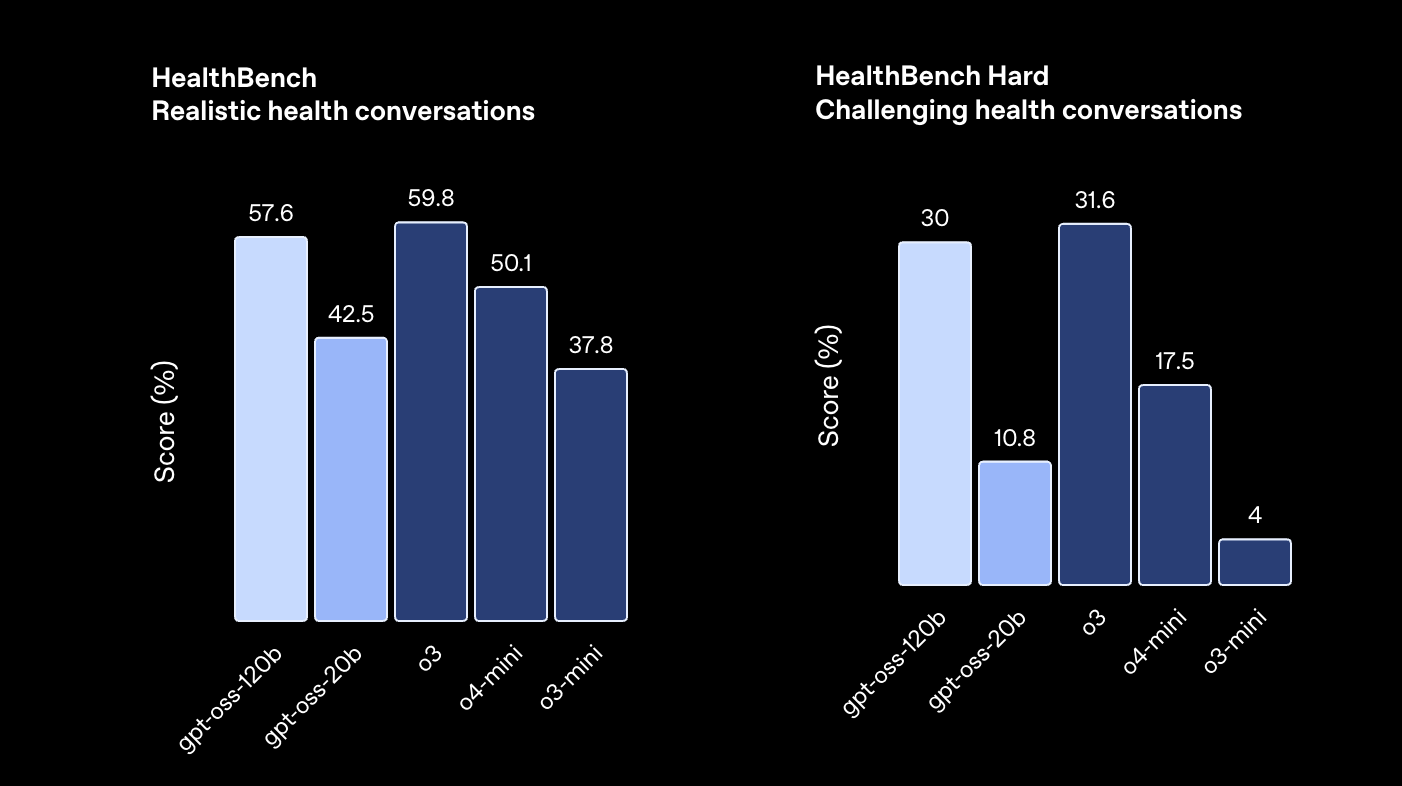
This is where the gpt-oss models really shine. On the HealthBench benchmark, both gpt-oss-120b and gpt-oss-20b significantly outperform their proprietary counterparts on realistic and challenging health conversations.
Math and Problem Solving
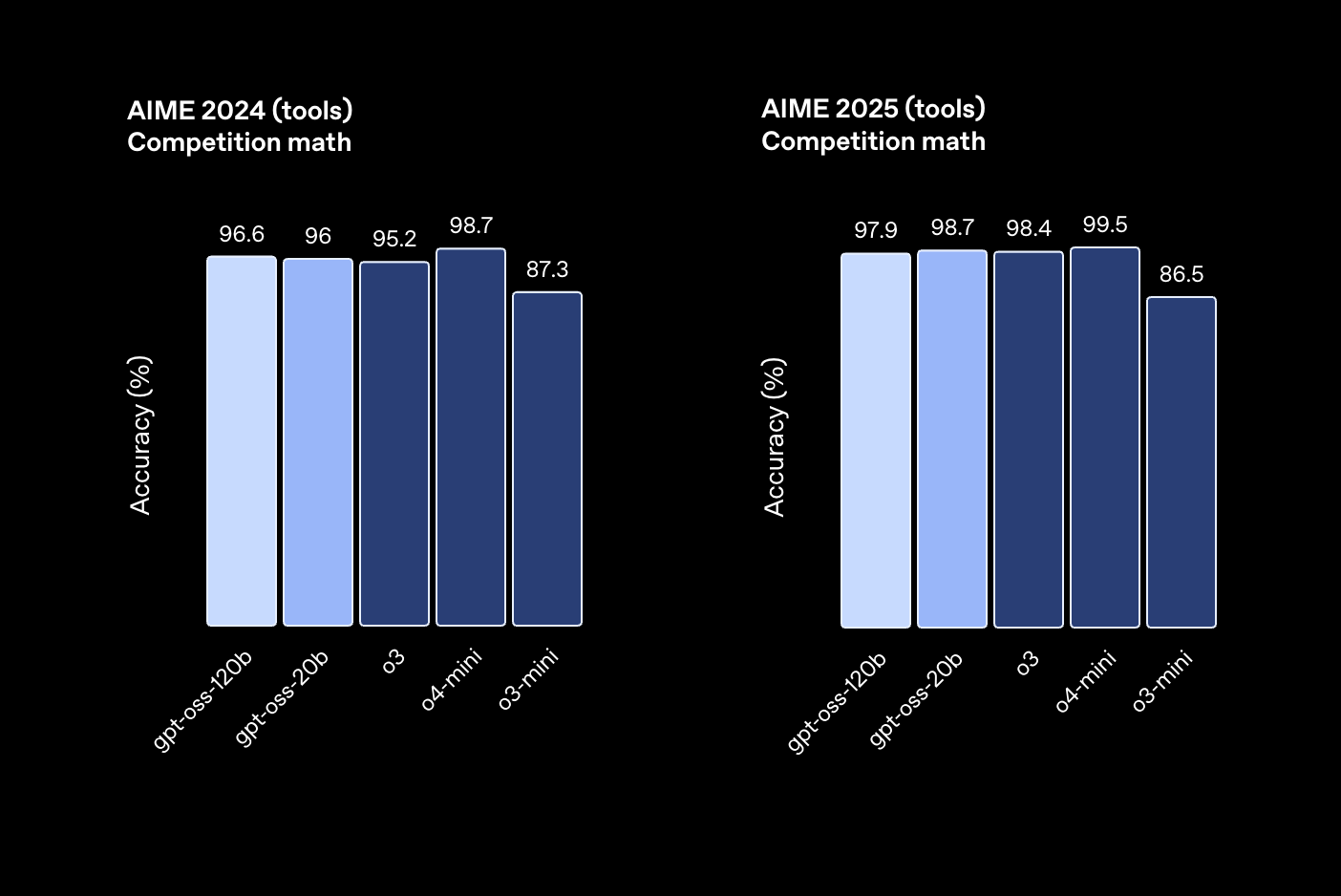
When it comes to competition-level math (like the AIME benchmarks), the gpt-oss models are neck-and-neck with the o4-mini, demonstrating top-tier reasoning capabilities.
Tool Use: Building the Future of AI Agents
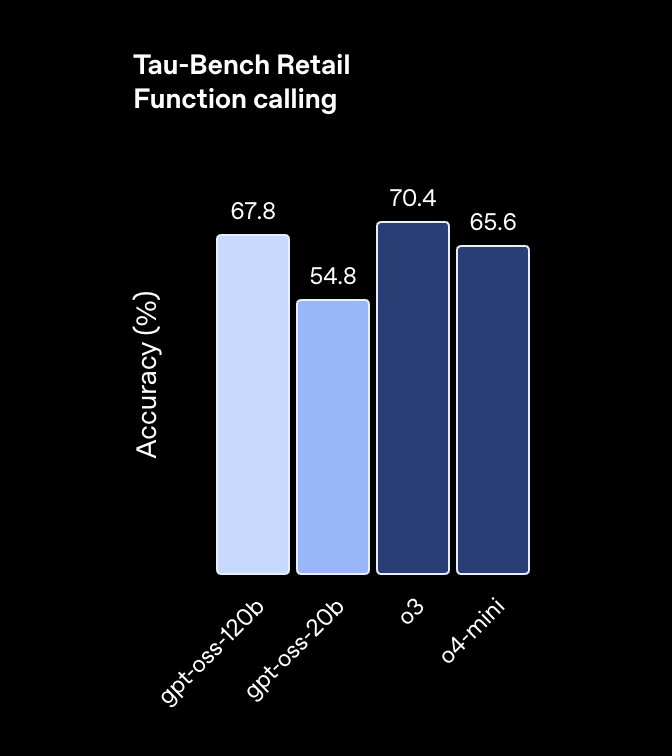
For building agents, tool-calling is critical. The gpt-oss-120b matches or even exceeds o4-mini on the Tau-Bench benchmark, making it a fantastic foundation for building tool-augmented AI systems.
The Nitty-Gritty: Architecture and Training
Under the hood, these are Transformer-based MoE models. They use clever tricks like:
- Alternating dense and sparse attention patterns for optimized inference
- Grouped multi-query attention for memory efficiency
- 128k token context window for handling large documents
- Emergent Chain-of-Thought (CoT) capability (not explicitly trained)
Important Note: OpenAI cautions developers not to expose the raw CoT output to end-users, as it's a reasoning trace, not a polished answer.
Safety and Community Collaboration
OpenAI is clearly taking safety seriously. They've:
- Filtered the pre-training data for harmful content
- Used "deliberative alignment" process for safety
- Conducted extensive adversarial testing
- Launched a $500,000 Red Teaming Challenge to crowdsource safety discovery
This is a brilliant move to strengthen the entire open-source ecosystem and get the community involved in safety research.
How to Get Your Hands on Them
This is the best part. The models are available right now on Hugging Face, quantized in MXFP4 format, which is how they achieve that impressive memory efficiency.
Quick Start with Hugging Face
from transformers import AutoTokenizer, AutoModelForCausalLM
import torch

# Load the model (choose your size)
model_name = "openai/gpt-oss-120b"  # or "openai/gpt-oss-20b"
tokenizer = AutoTokenizer.from_pretrained(model_name)
model = AutoModelForCausalLM.from_pretrained(
    model_name,
    torch_dtype=torch.float16,
    device_map="auto"
)

# Generate text
inputs = tokenizer("Write a Python function to calculate fibonacci numbers:", return_tensors="pt")
outputs = model.generate(**inputs, max_length=200)
print(tokenizer.decode(outputs[0], skip_special_tokens=True))
Deployment Options
OpenAI has clearly done the legwork to ensure broad adoption. There's already support from a huge list of partners:
- vLLM: Optimized inference engine
- Ollama: Easy local deployment
- LM Studio: User-friendly interface
- Azure & AWS: Cloud deployment
- NVIDIA & AMD: Hardware optimization
- Microsoft: GPU-optimized gpt-oss-20b on Windows via ONNX Runtime
Why This Matters
This release is a massive step forward for open-source AI. By providing models that are not only powerful but also efficient and accessible, OpenAI is empowering developers to build the next generation of AI applications without being tethered to a proprietary API.
Key Benefits
- Freedom: Run models on your own infrastructure
- Cost Control: No per-token pricing or API limits
- Customization: Fine-tune for your specific use cases
- Privacy: Keep sensitive data on-premises
- Innovation: Build new applications without API constraints
Comparison with Other Models
vs. Proprietary Models (GPT-4, Claude)
- Performance: Competitive with o4-mini across benchmarks
- Cost: Significantly lower total cost of ownership
- Control: Full control over deployment and customization
- Privacy: No data sent to external APIs
vs. Other Open Source Models
- Efficiency: MoE architecture provides better cost-performance ratio
- Tool Use: Superior tool-calling capabilities
- Safety: Extensive safety testing and alignment
- Support: Backed by OpenAI's research and development
Use Cases and Applications
Software Development
- Code Generation: From requirements to production-ready code
- Code Review: Automated analysis and suggestions
- Debugging: Intelligent error detection and resolution
- Documentation: Automatic technical documentation generation
Research and Analysis
- Data Analysis: Statistical analysis and visualization
- Literature Review: Systematic research paper analysis
- Report Generation: Professional reports with insights
- Market Research: Competitive analysis and trend identification
Business Applications
- Process Automation: Workflow optimization
- Decision Support: Data-driven insights
- Customer Service: Intelligent chatbots and assistants
- Content Creation: Technical writing and documentation
Getting Started Today
Immediate Access Options
- Hugging Face: Download models directly from openai/gpt-oss-120b and openai/gpt-oss-20b
- Ollama: Quick local deployment with
ollama pull gpt-oss-20b - vLLM: High-performance inference server
- LM Studio: User-friendly desktop application
Recommended Learning Path
- Start with gpt-oss-20b: Lower memory requirements for experimentation
- Test on your use cases: Benchmark against your specific requirements
- Explore tool integration: Build agentic workflows
- Scale to production: Deploy gpt-oss-120b for high-performance applications
Conclusion: The Future of Open AI
OpenAI's release of gpt-oss models represents a paradigm shift in the AI landscape. By making powerful, efficient models available as open-weight software, they're democratizing access to cutting-edge AI technology.
Whether you're a researcher exploring new AI capabilities, a developer building the next generation of applications, or an organization looking to deploy AI solutions on your own infrastructure, the gpt-oss models provide the foundation for innovation without the constraints of proprietary APIs.
Ready to explore the future of open AI? Download the models from Hugging Face and start building today! 🚀
Related Resources
Have questions about gpt-oss or want to share your implementation experience? Feel free to reach out on Twitter or LinkedIn.
This essay keeps its original canonical home at blog.lordpatil.com.