By Lordpatil · · 3 min read
Top Talent: The OpenAI Database Story
An analysis of OpenAI's database scaling and the CMU talent pipeline behind it.
OpenAI recently dropped a technical deep dive that has database enthusiasts buzzing: Scaling PostgreSQL to power 800 million ChatGPT users. The article is a masterclass in reliability engineering, detailing how they handle millions of queries per second with a seemingly simple architecture.
But if you look closer at the byline, there’s a fascinating "talent pipeline" story hidden in plain sight.
The Andy Pavlo Effect
The blog was authored by Bohan Zhang, who studied at Carnegie Mellon University (CMU) under the legendary database professor Andy Pavlo.
If you work in databases and don't know Andy Pavlo, you might have missed a chapter in your education. He's the kind of professor who hunts down primary sources to settle debates—like personally confirming with the original authors of the B-Tree paper that the "B" actually stands for Boeing (where the database was originally developed to track parts), not "Binary" or "Balanced" as commonly believed.
It seems Pavlo’s rigorous teaching style produces engineers capable of solving some of the world's hardest scaling problems.
Visualizing the Talent Pipeline
This isn't just an anecdote about one engineer. A look at the educational background of OpenAI employees reveals a clear trend.
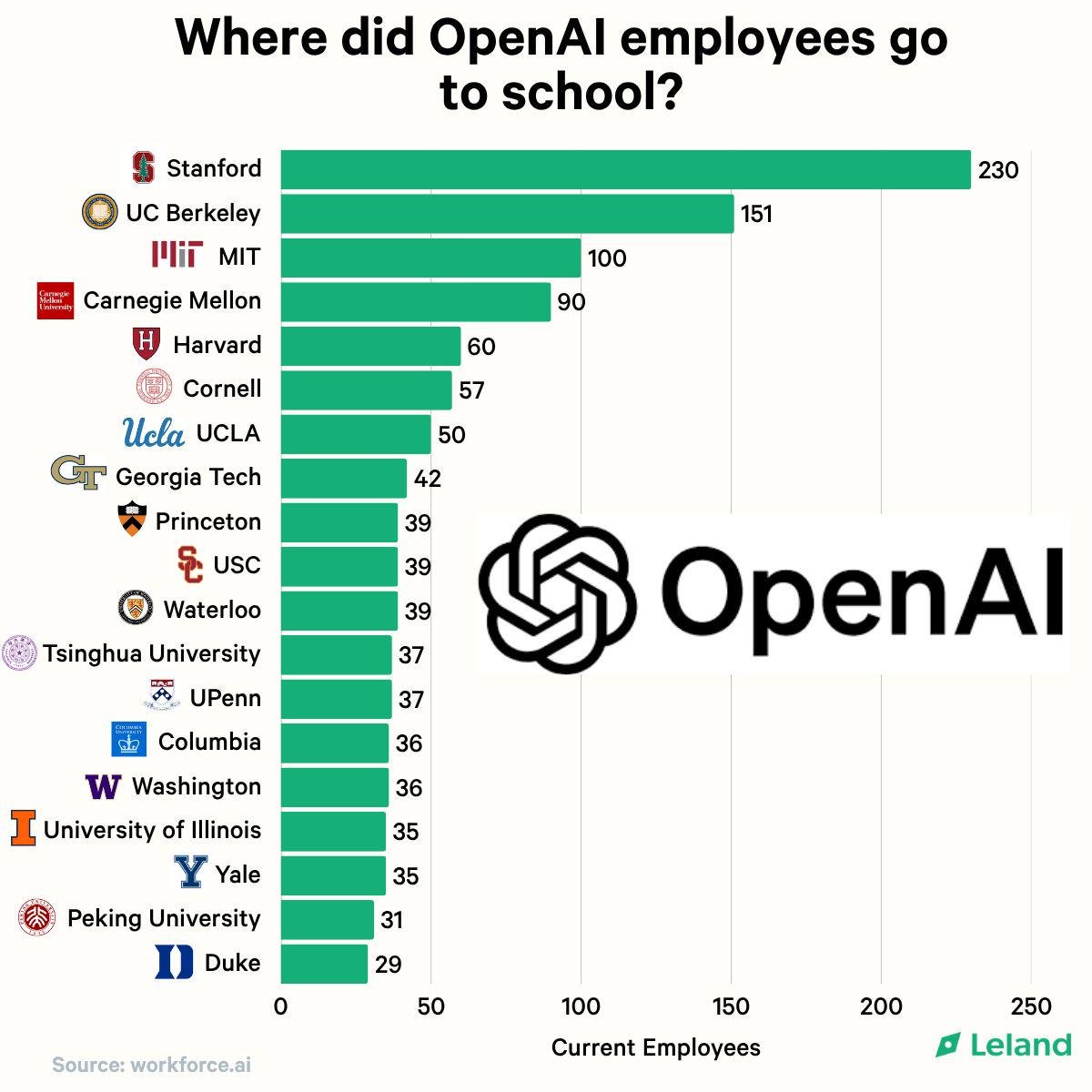
As the chart above shows, Carnegie Mellon is the 4th largest feeder school for OpenAI, with 90 employees currently shaping the future of AI. It sits right up there with Stanford, Berkeley, and MIT. When you're building systems that need to serve nearly a billion users, you don't just need hardware; you need engineers who understand the fundamental theory of data structures and distributed systems.
How They Did It: Scaling for 800 Million
So, how did this CMU-backed team actually scale Postgres to ChatGPT levels? The strategy was surprisingly grounded in fundamentals rather than exotic new tech:
- Read Heavy Architecture: They utilized a single primary instance supported by nearly 50 read replicas to absorb the massive read traffic.
- Strategic Sharding: Write-heavy workloads (like conversation history) were migrated to sharded systems like Azure Cosmos DB, keeping the relational database focused on metadata and state where ACID compliance mattered most.
- Query Discipline: The team optimized queries to avoid expensive multi-table joins, effectively doing "joins in the application" where necessary to preserve DB cycles.
- Traffic Control: They implemented strict connection pooling (using PgBouncer) and a custom cache locking mechanism to prevent "thundering herd" problems when caches expire.
Conclusion
The OpenAI engineering blog is a great read for the technical details, but it also serves as a testament to the quality of education at institutions like CMU. Scaling a system to 800 million users isn't just about throwing more servers at the problem—it's about understanding the "B" in the B-Tree and applying those first principles to modern infrastructure.